If a herniated or bulging disc is behind your back or leg pain, you have probably come across two ways to take pressure off the spine: an inversion table you use at home, and spinal decompression in a clinic. Both pull the spine gently apart. Only one of them was built around the disc.
Spinal decompression is built for disc problems
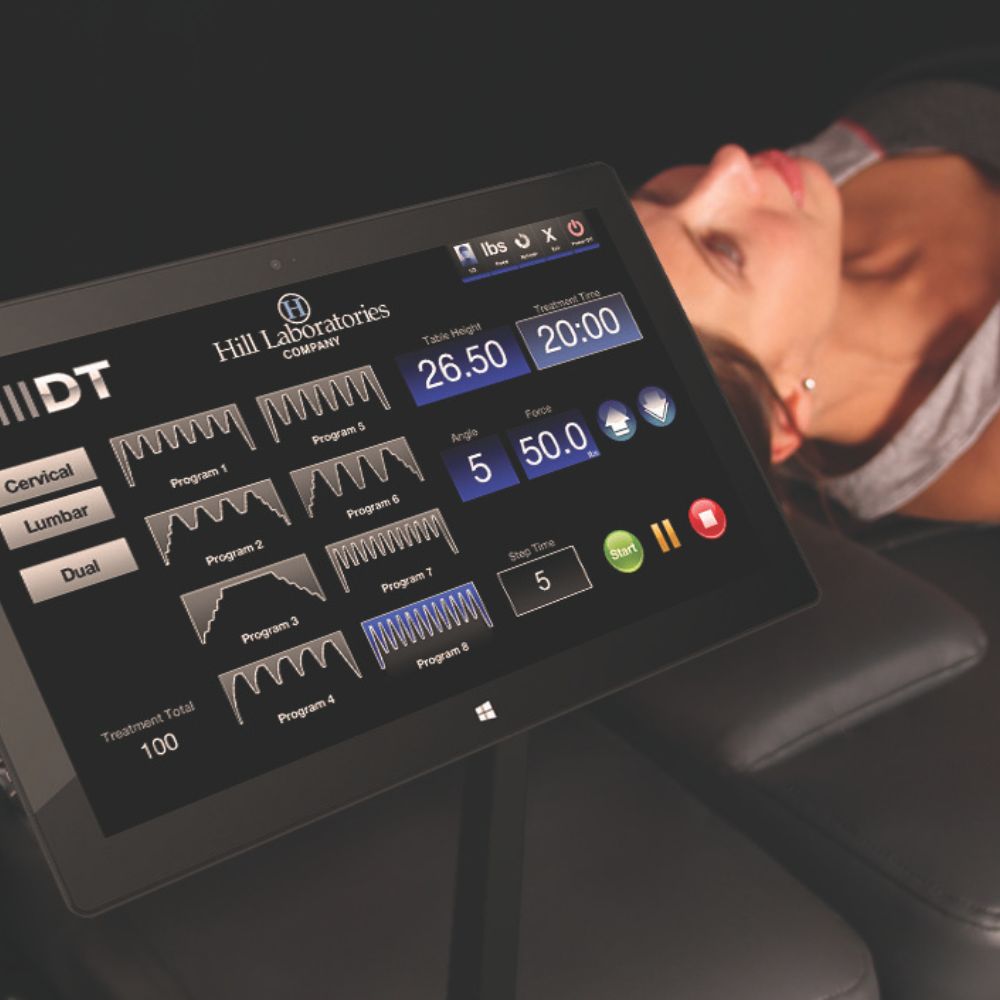
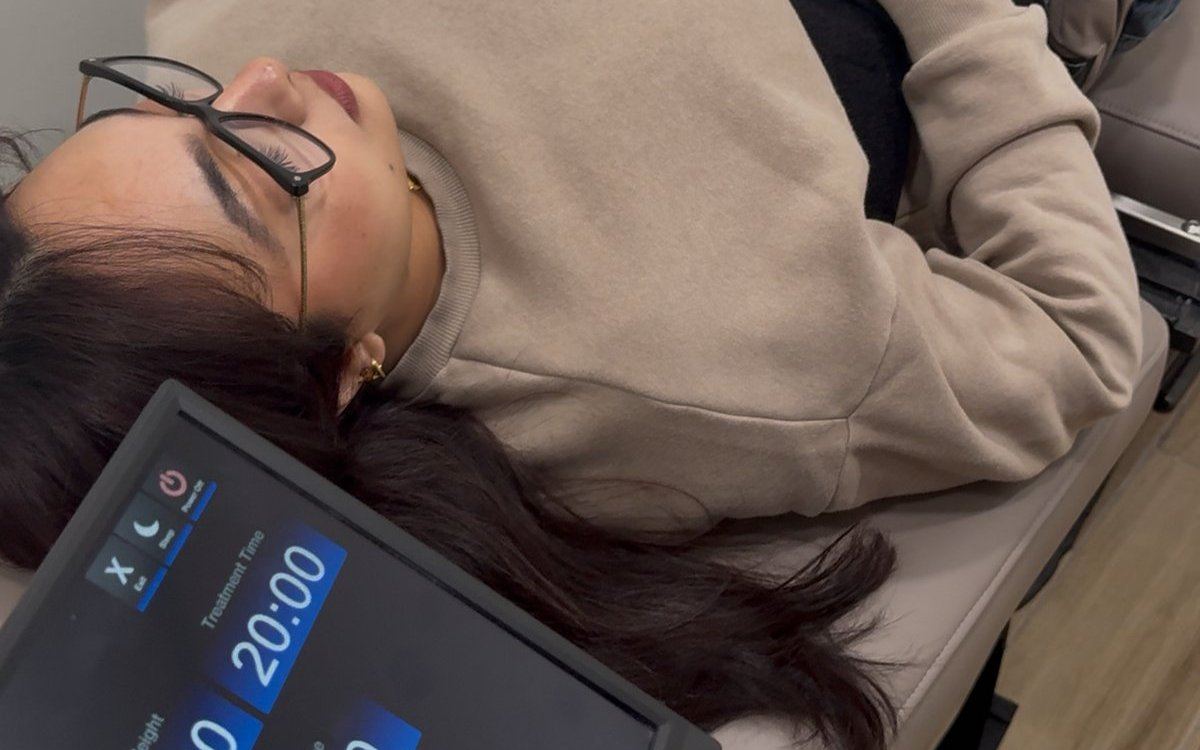
Spinal decompression uses a motorized, computer-controlled table. You lie on it fully clothed, face up or face down, with one harness around your pelvis and another around your chest. The angle of the pull is set to focus on the disc level your exam and imaging point to, so the stretch is aimed where the problem is instead of spread along the whole spine.
The pull builds gradually, holds, and then releases, in cycles. That slow build is designed so the muscles along your spine stay relaxed instead of tightening up and guarding against the pull. The force and angle are set for you and can be adjusted from one session to the next.
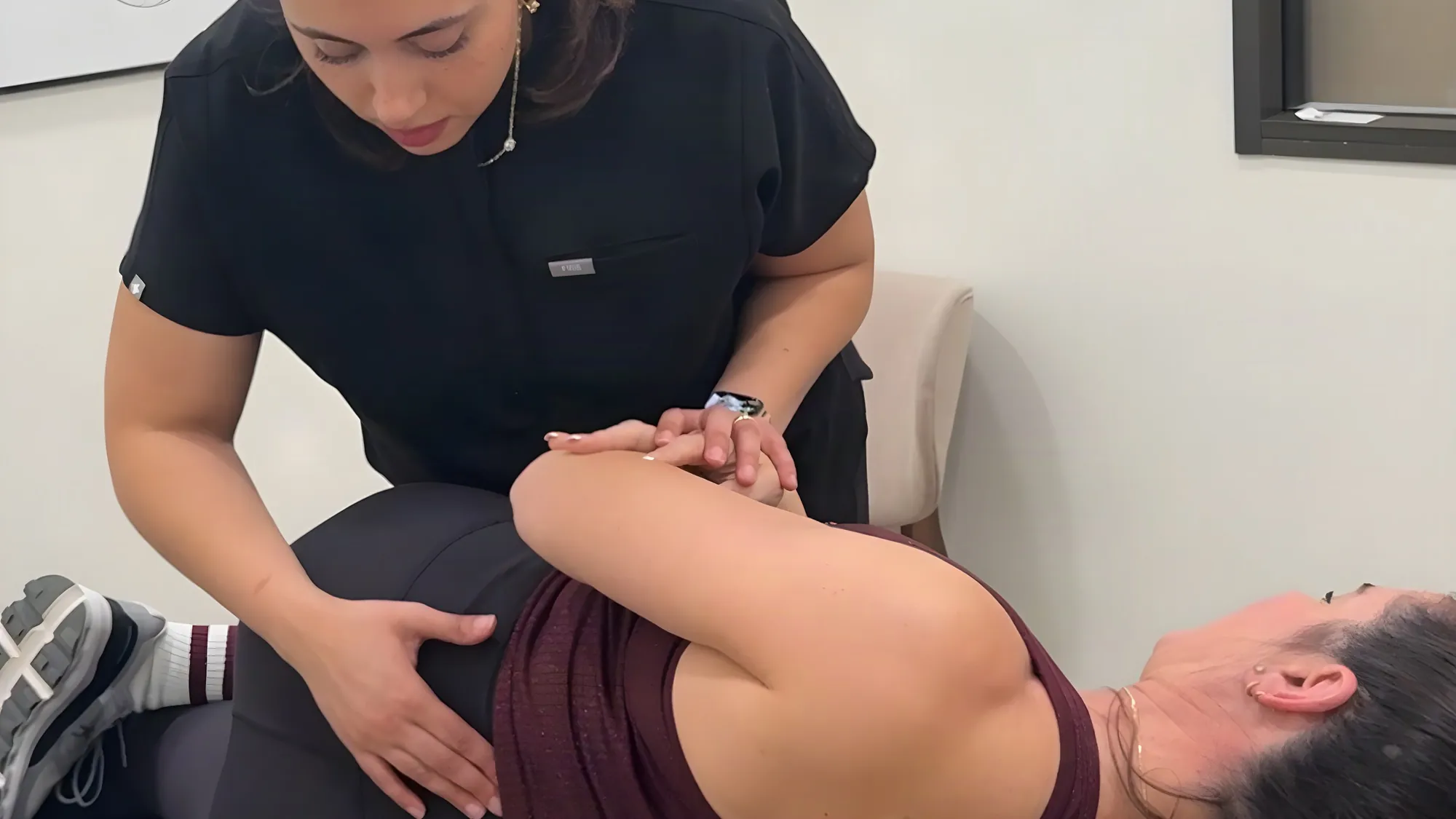
Sessions take place in our office under the supervision of Dr. Mariam Mobarak, DC, and only after a physical and neurological exam and X-rays taken here in the office.
The vacuum effect: negative pressure measured inside the disc
Decompression is designed to create negative pressure inside the disc, the effect people often call a vacuum. This has been measured. In a 1994 study in the Journal of Neurosurgery, researchers placed a pressure sensor inside the L4-5 disc of patients lying face down on a VAX-D decompression table. As the table increased its pull, the pressure inside the disc fell, and at the higher settings it dropped below zero, to under -100 mm Hg (Ramos and Martin, 1994).
That negative pressure may help draw pressure off the disc and the nerve beside it. It was a small study, but it is a direct measurement taken inside the disc during decompression.
We have not found a comparable measurement for inversion tables. Inversion studies have shown the spaces between the lower lumbar vertebrae widening on X-ray (Gianakopoulos and colleagues, 1985), and a computer model estimated lower disc pressure during head-down tilt traction (Wang and colleagues, 2017). Neither one measured pressure inside a person's disc during inversion.
How an inversion table works
You strap your ankles in and tilt back until your head is lower than your feet. Gravity pulls your upper body toward the floor and stretches the spine. The steeper the angle, the stronger the pull. At full inversion, your whole body weight hangs from your ankles.
That pull cannot be aimed at one disc. It spreads along the whole spine, and its strength depends on your weight and how far you tip back. You are usually at home and alone, choosing the angle and the time yourself.
Inversion does have some research behind it. In a 2012 pilot trial of 24 people waiting for surgery on one lumbar disc, fewer people in the group that added inversion to physiotherapy went on to have surgery. Pain and disability scores did not differ between the groups, and the authors called for a larger trial (Prasad and colleagues, 2012).
The safety side of hanging upside down
Putting your head below your heart raises pressure in the head and chest. In a 1986 study of 60 young women, those inverted for two minutes had significant rises in both systolic and diastolic blood pressure compared with those who stayed standing, and the authors wrote that people with high blood pressure may need to avoid it (Haskvitz and Hanten, 1986). In a 1985 study of 20 adults with chronic low back pain, blood pressure rose by an average of about 17 points while inverted, a few people had headaches or blurred vision that lingered, and the authors advised using inversion devices under medical supervision (Gianakopoulos and colleagues, 1985).
Eye pressure climbs too. Five minutes after full inversion, pressure inside the eye roughly doubled in healthy eyes in a 1984 study, and the researchers recommended that people with glaucoma or high eye pressure avoid inversion (Weinreb and colleagues, 1984). Falls are the other concern: a 2023 article on U.S. FDA device reports describes serious inversion table injuries, including spinal cord injuries and fractures (Kassay and colleagues, 2023).
Talk with your medical doctor before using an inversion table if you have high blood pressure, glaucoma or a retinal problem, heart disease or a history of stroke, if you are pregnant, or if you have had recent surgery.
Side by side
Targets the problem disc
- Inversion table: gravity stretches the whole spine at once and cannot be aimed at one level.
- Spinal decompression: the angle of the pull is set to focus on the disc level your exam and imaging point to.
Controlled force
- Inversion table: the force comes from your body weight and the angle you pick.
- Spinal decompression: a computer sets the force and cycles it, building and releasing in a way designed to keep the muscles from guarding.
Designed to create negative disc pressure (measured in research)
- Inversion table: we have not found a published measurement of pressure inside the disc during inversion.
- Spinal decompression: pressure inside the disc was measured dropping below zero on a decompression table in a 1994 study.
Supervised by a doctor
- Inversion table: usually done alone at home.
- Spinal decompression: done in our office under Dr. Mobarak's supervision, with settings adjusted from session to session.
Safety for high blood pressure, glaucoma and pregnancy
- Inversion table: the head-down position raises blood pressure and eye pressure, so it is not advised with high blood pressure, glaucoma or retinal problems, heart conditions or pregnancy.
- Spinal decompression: you lie flat with no head-down position, and your exam screens for reasons it is not a fit first. It is not used during pregnancy, and prenatal chiropractic care with the Webster technique is offered instead. Some people feel mild soreness afterward.
Paired with an exam and X-rays
- Inversion table: nobody examines you before you buy one or use it.
- Spinal decompression: every new patient starts with a physical and neurological exam and X-rays taken in the office.
Why many patients with disc problems choose decompression
Many patients with disc problems choose decompression because it is built for that problem. The pull is aimed at the affected level, a computer controls it, it is designed to create negative pressure inside the disc, and a doctor who has examined you supervises it. An inversion table stretches the whole spine the same way every time and leaves you to manage it on your own.
Several studies on decompression report encouraging results, though controlled trials are still limited and the research is still growing. In a 2010 study of 30 adults with lumbar disc herniation, average pain scores fell from 6.2 to 1.6 out of 10 over six weeks of decompression, and disc height measured on CT scans increased. That study had no comparison group, and its authors called for a randomized trial (Apfel and colleagues, 2010). A 2006 review found that most earlier randomized trials of motorized decompression showed no clear difference from the comparison treatments. The reviewers rated those trials as low quality, noted that mixed patient groups and the difficulty of blinding patients to the pull may have played a part, and called for larger, better-designed studies (Macario and Pergolizzi, 2006).
When to skip both and get checked
Loss of bladder or bowel control, numbness around the groin or inner thighs, or leg weakness that is getting worse can signal cauda equina syndrome. Go to an emergency room. Neither table is the right answer for that.
Find out if decompression fits your disc problem
If a herniated or bulging disc is behind your pain, spinal decompression is built for that problem in a way an inversion table is not. Book an exam to see if you are a candidate.
The $99 covers your exam, X-rays and your first treatment. Dr. Mobarak goes over the findings with you, and together you talk through whether spinal decompression, chiropractic adjustments or another approach makes sense for your goals. You can also read more about herniated discs and sciatica, or our article on decompression and surgery.
Book your exam online or call (281) 688-5580. We are at the corner of Woodlands Parkway and FM 2978 in The Woodlands.
Sources
- Ramos G, Martin W. Effects of vertebral axial decompression on intradiscal pressure. J Neurosurg. 1994;81(3):350-353. PubMed 8057141
- Gianakopoulos G, et al. Inversion devices: their role in producing lumbar distraction. Arch Phys Med Rehabil. 1985;66(2):100-102. PubMed 3155939
- Wang S, et al. Biomechanical analysis of combining head-down tilt traction with vibration for different grades of degeneration of the lumbar spine. Med Eng Phys. 2017;39:83-93. PubMed 27816390
- Prasad KS, et al. Inversion therapy in patients with pure single level lumbar discogenic disease: a pilot randomized trial. Disabil Rehabil. 2012;34(17):1473-1480. PubMed 22263648
- Haskvitz EM, Hanten WP. Blood pressure response to inversion traction. Phys Ther. 1986;66(9):1361-1364. PubMed 2944136
- Weinreb RN, Cook J, Friberg TR. Effect of inverted body position on intraocular pressure. Am J Ophthalmol. 1984;98(6):784-787. PubMed 6507552
- Kassay A, Soliman MAR, Jhawar BS. Recommendations for inversion table therapy. Disabil Rehabil. 2023;45(22):3779-3782. PubMed 36444821
- Apfel CC, et al. Restoration of disk height through non-surgical spinal decompression is associated with decreased discogenic low back pain: a retrospective cohort study. BMC Musculoskelet Disord. 2010;11:155. PubMed 20615252
- Macario A, Pergolizzi JV. Systematic literature review of spinal decompression via motorized traction for chronic discogenic low back pain. Pain Pract. 2006;6(3):171-178. PubMed 17147594
The $99 covers your exam, X-rays and your first treatment.
Call (281) 688-5580 or book online to schedule.
Dr. Mariam Mobarak, DC
Dr. Mariam Mobarak is the chiropractor at Blue Zone Advanced Chiropractic in The Woodlands. She combines several chiropractic techniques with therapies like spinal decompression, shockwave and dry needling, and your care is built around your exam and your goals.
TechniquesActivator, Diversified, Gonstead, Thompson, Upper Cervical and Webster
Meet our doctor →︎