Some headaches seem to climb up from the neck. They start at the base of the skull, spread over the top of the head toward the eye, and get worse after a long day at the computer or a night on the wrong pillow. If that sounds familiar, the neck itself may be the source. This type has a name: cervicogenic headache.
What a cervicogenic headache is
A cervicogenic headache is pain felt in the head that comes from a problem in the neck. The International Headache Society lists it as its own headache type (ICHD-3, 2018).
The explanation comes down to wiring. Nerves from the upper three levels of the neck feed into the same area of the brainstem as nerves from parts of the head. Laboratory and clinical studies show that pain from the upper neck joints and muscles can be referred to the head (Bogduk and Govind, 2009). Your brain receives the signal and reads it as a headache.
It is less common than many people think. A review estimated cervicogenic headache affects 0.4 to 2.5 percent of the general population, but 15 to 20 percent of people with chronic headaches (Haldeman and Dagenais, 2001).
Signs the headache may be coming from your neck
The diagnostic criteria published by an international study group describe a pattern that often includes the following (Sjaastad and colleagues, 1998):
- Pain on one side of the head that does not switch sides
- Pain that starts in the neck or the back of the head and spreads forward
- Headaches brought on by neck movement, awkward neck positions or pressure on the back of the neck
- A stiff neck with less range of motion than usual
- Pain in the shoulder or arm on the same side
Migraines and tension-type headaches can overlap with this picture. Migraines more often bring throbbing pain, nausea, and sensitivity to light and sound. Tension-type headaches tend to feel like a tight band on both sides. Many people have more than one type, which is why an exam matters more than a guess.
What tends to set it off
Common contributors include long hours with the head forward over a laptop or phone, old injuries such as whiplash from a car accident, stiffness in the upper neck joints, and tight muscles at the base of the skull and across the shoulders. Our article on forward head posture covers the desk side of the problem in more detail.
What the research says about care
The research supports hands-on care and exercise, with honest limits. In a trial of 200 people with cervicogenic headache, manipulative therapy and a low-load exercise program each reduced headache frequency and intensity, and the effects held at 12 months (Jull and colleagues, 2002). The exercises focused on the deep muscles at the front of the neck and the muscles around the shoulder blades.
A 2018 trial of 256 adults compared different numbers of spinal manipulation visits with a light massage control. The group that received 18 sessions cut their headache days roughly in half, from about 16 to about 8 days a month. That was about 3 more headache-free days a month than the control group (Haas and colleagues, 2018).
A systematic review found that manual therapies might be effective for cervicogenic headache, but said the studies were hard to compare and called for better trials (Chaibi and Russell, 2012). Care can help many people, and it is not a guarantee for everyone.
What an exam looks at
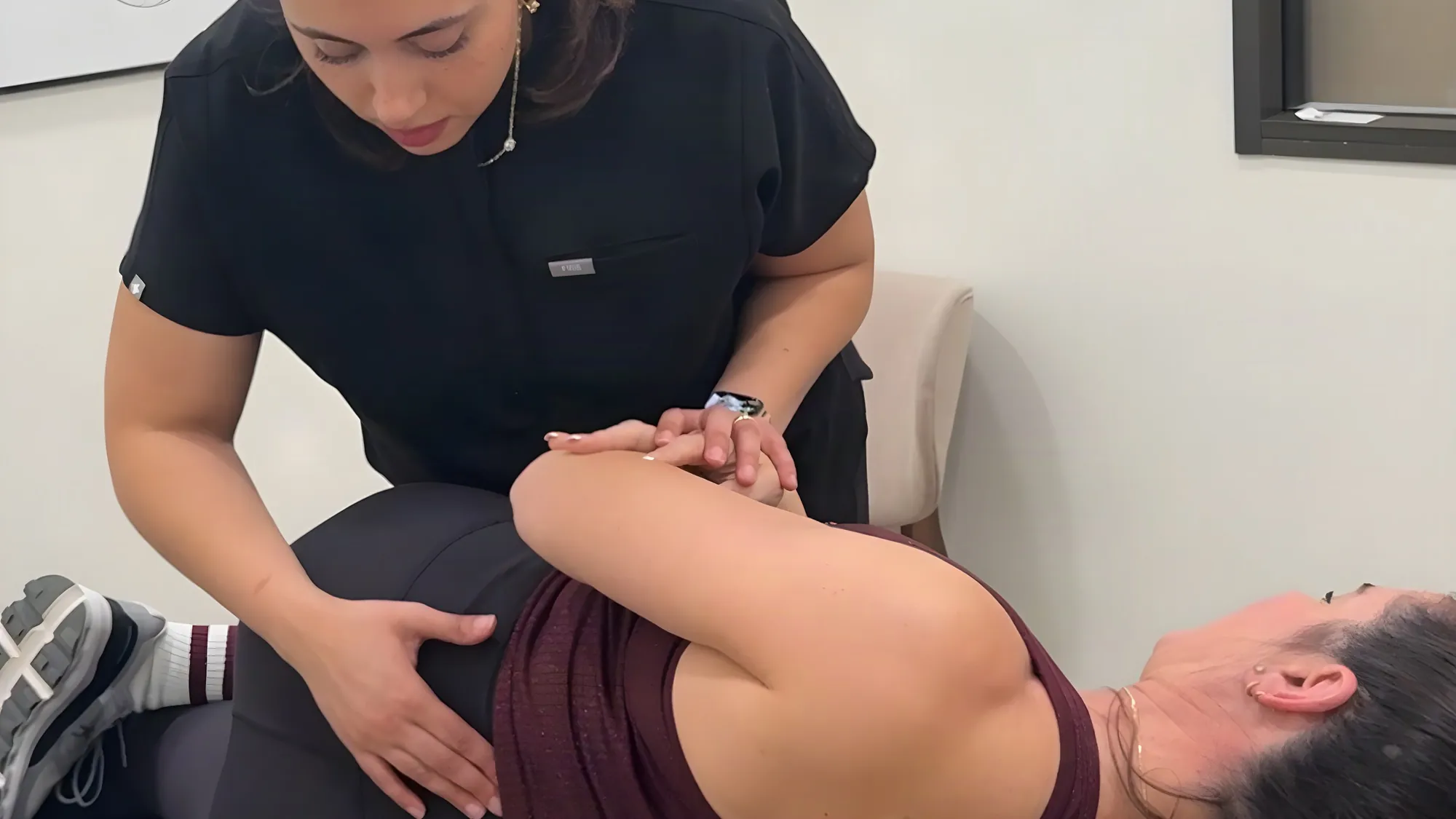
At Blue Zone Advanced Chiropractic, a first visit includes a conversation about your headache pattern, a physical and neurological exam, a check of how each level of your neck moves, and X-rays taken in our office. X-rays are part of every new patient visit. The $99 covers your exam, X-rays and your first treatment.
Dr. Mariam Mobarak, DC then goes over the findings with you. Options you can discuss include chiropractic adjustments with methods such as Diversified, Activator or Upper Cervical, dry needling for tight neck and shoulder muscles, and exercises to do at home. See our pages on headaches and migraines and neck pain for more.
Headache warning signs that need medical care first
Some headaches are not a chiropractic problem. Call 911 or go to an emergency room for:
- A sudden, severe headache that peaks within a minute or so
- Headache with fever and a stiff neck
- Headache after a blow to the head
- New weakness, numbness, vision loss, confusion or trouble speaking
- Sudden neck pain with dizziness, double vision, or trouble speaking or swallowing
A new headache pattern after age 50, or one that keeps getting worse, should be checked by your medical doctor. These situations are outside the scope of chiropractic care, and we will refer you if we see them.
Book a visit
Book online or call (281) 688-5580. Blue Zone Advanced Chiropractic is at 30340 FM 2978, Suite 600, The Woodlands, TX 77354, at the corner of Woodlands Parkway and FM 2978.
Sources
- Headache Classification Committee of the International Headache Society. The International Classification of Headache Disorders, 3rd edition. Cephalalgia. 2018;38(1):1-211. PubMed 29368949
- Bogduk N, Govind J. Cervicogenic headache: an assessment of the evidence on clinical diagnosis, invasive tests, and treatment. Lancet Neurol. 2009;8(10):959-968. PubMed 19747657
- Haldeman S, Dagenais S. Cervicogenic headaches: a critical review. Spine J. 2001;1(1):31-46. PubMed 14588366
- Sjaastad O, Fredriksen TA, Pfaffenrath V. Cervicogenic headache: diagnostic criteria. Headache. 1998;38(6):442-445. PubMed 9664748
- Jull G, et al. A randomized controlled trial of exercise and manipulative therapy for cervicogenic headache. Spine. 2002;27(17):1835-1843. PubMed 12221344
- Haas M, et al. Dose-response and efficacy of spinal manipulation for care of cervicogenic headache: a dual-center randomized controlled trial. Spine J. 2018;18(10):1741-1754. PubMed 29481979
- Chaibi A, Russell MB. Manual therapies for cervicogenic headache: a systematic review. J Headache Pain. 2012;13(5):351-359. PubMed 22460941
The $99 covers your exam, X-rays and your first treatment.
Call (281) 688-5580 or book online to schedule.
Dr. Mariam Mobarak, DC
Dr. Mariam Mobarak is the chiropractor at Blue Zone Advanced Chiropractic in The Woodlands. She combines several chiropractic techniques with therapies like spinal decompression, shockwave and dry needling, and your care is built around your exam and your goals.
TechniquesActivator, Diversified, Gonstead, Thompson, Upper Cervical and Webster
Meet our doctor →︎