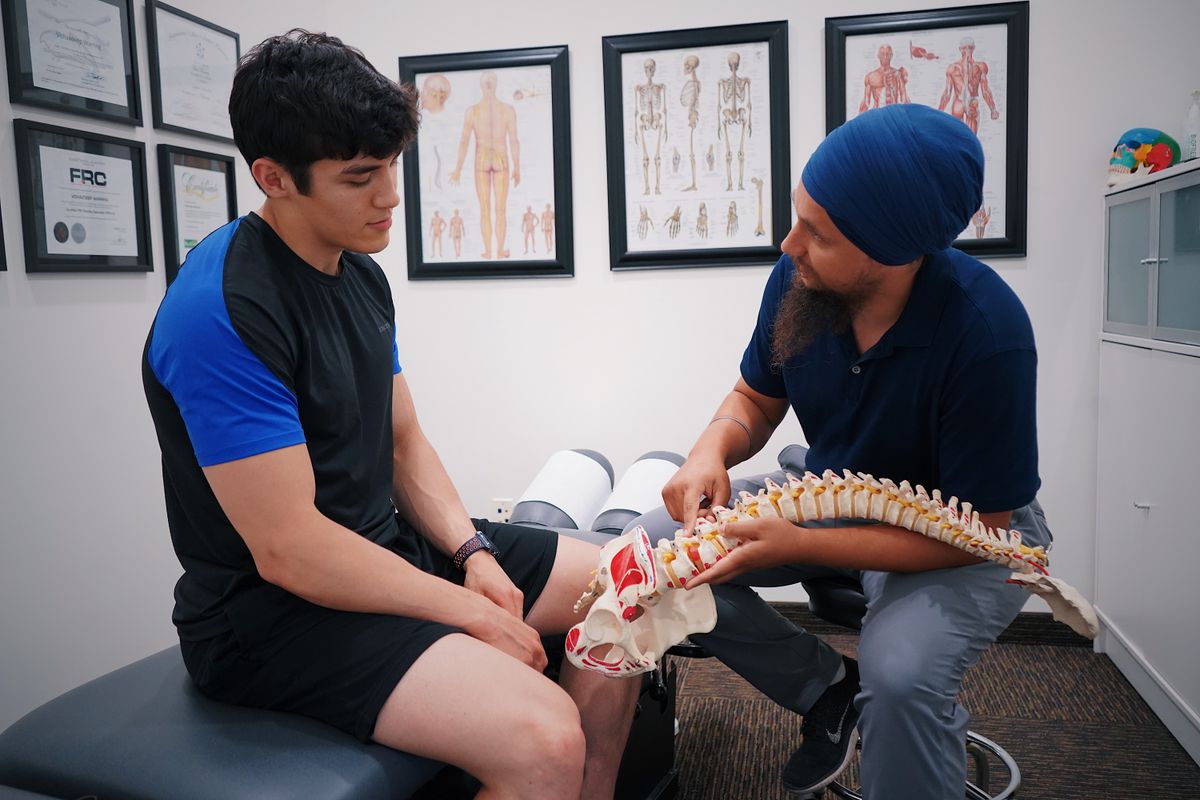
New patients almost always ask about the sound. Some are afraid of it. Others chase it — if they didn't hear a loud pop, they assume the adjustment "didn't work." Both reactions come from the same misunderstanding of what that noise actually is.
The pop is gas, not bone
Your spinal joints are sealed capsules filled with synovial fluid, which contains dissolved gases — mostly carbon dioxide. During an adjustment, the joint surfaces separate quickly, pressure inside the capsule drops, and the dissolved gas forms a bubble that collapses almost instantly. That collapse is the pop. Researchers have watched it happen in real time under MRI. Nothing is grinding, snapping, or being forced "back into place."
Why the sound doesn't measure the adjustment
The therapeutic effect of an adjustment comes from restoring motion to a restricted joint and the neurological response that follows — a burst of input from joint mechanoreceptors that relaxes surrounding muscle guarding and recalibrates how your nervous system maps that segment. All of that happens whether or not cavitation occurs.
Some joints cavitate easily. Some don't, especially if they've been restricted for years or if you're well hydrated and the gas content of your synovial fluid is low that day. Instrument-assisted techniques and gentle mobilization often produce no sound at all and still restore motion measurably. I've had patients get their biggest breakthroughs from adjustments they barely heard.
Why relief often follows the pop anyway
Cavitation does stretch the joint capsule and trigger a brief endorphin release, so the sound often coincides with an immediate sense of ease. That's real — it's just not the whole treatment. The lasting change comes from the restored joint motion, the follow-up care, and the strengthening work that keeps the segment moving.
When a pop is the wrong goal
Chasing the loudest possible crack is how people end up repeatedly gapping hypermobile joints — the segments that already move too much — while the restricted one stays locked. This is the core problem with self-cracking and with any care that treats the sound as the outcome. At our Woodlands office, the goal is always specific: find the segment that isn't moving, restore its motion, and confirm the change with re-examination, not with volume.
What patients should actually pay attention to
After a well-targeted adjustment you should notice improved range of motion, less muscle guarding, and easier movement over the following days. Those are the metrics that matter. If you're being adjusted regularly and the only outcome is a satisfying noise that wears off by evening, that's a sign the actual restriction isn't being addressed.
If you've been curious about chiropractic but the sound has kept you away, know this: gentle, low-force, and instrument-assisted options exist, they're quiet, and they work. The pop is physics, not the point.