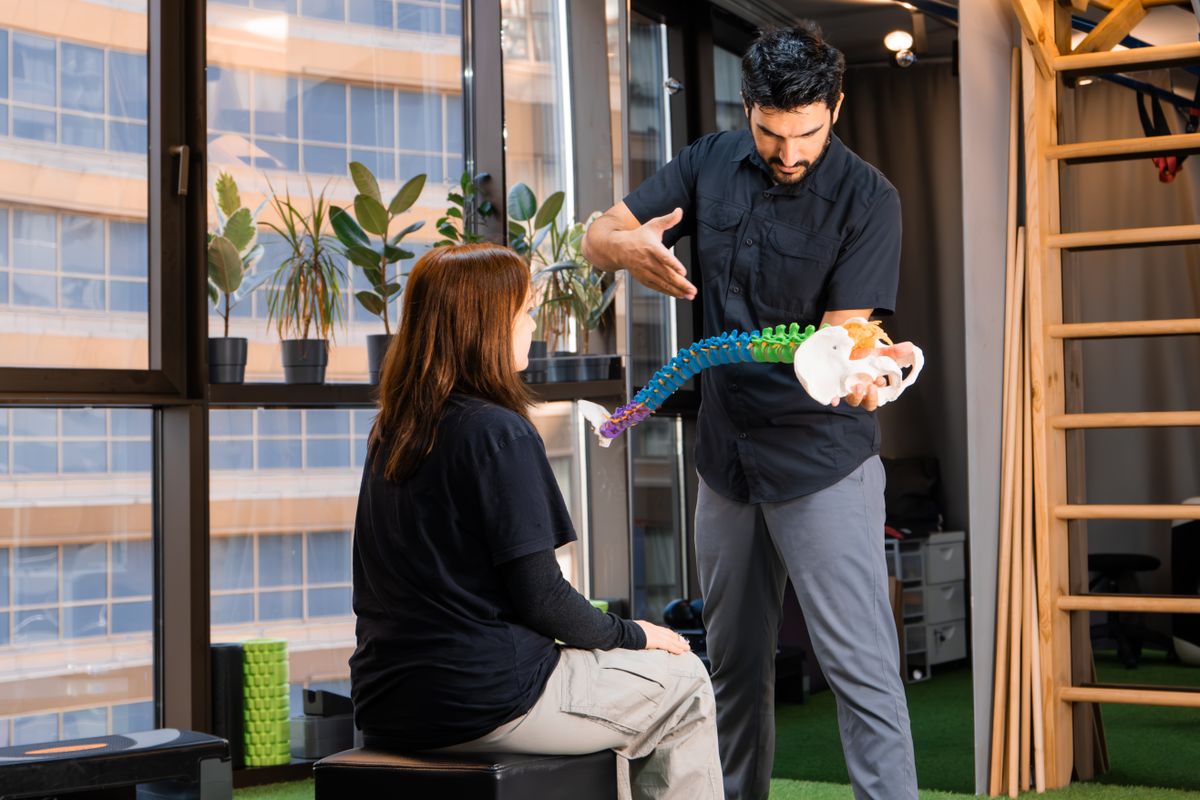
Let's start with the sentence some chiropractic websites won't print: chiropractic adjustments do not straighten structural scoliosis. If a provider promises to reduce your curve with a long prepaid plan of adjustments, walk out. Now let's talk about what honest care actually offers adults with scoliosis — because it's genuinely useful, just not magical.
Structural vs. functional curves
Structural scoliosis involves the bones themselves — vertebrae that grew with rotation and asymmetry, usually appearing in adolescence, or curves that develop later in life as discs and joints degenerate unevenly. The curve is built into the architecture, and no amount of adjusting reshapes bone.
Functional scoliosis is different: the spine curves because something else is off — a leg-length difference, pelvic rotation, or one-sided muscle spasm. The vertebrae are normal. Correct the underlying driver and this type of curve can genuinely reduce or resolve. Part of a good exam is figuring out which kind you have, because the answer changes everything.
What adults with scoliosis actually struggle with
For most adults, the problem isn't the curve's cosmetic angle — it's what living with asymmetry does over time. The concave side stiffens and compresses; the convex side muscles work overtime and ache. Certain joints bear uneven load and degenerate faster. Stiffness, one-sided back pain, muscle fatigue, and in degenerative cases, nerve symptoms. These are the targets that respond to conservative care.
What the evidence supports
Reviews of the research are consistent: evidence that manipulation changes curve magnitude is weak to nonexistent, but chiropractic care combined with targeted exercise can improve pain, flexibility, and quality of life for scoliosis patients. That aligns exactly with what we see clinically. Adjustments and mobilization keep the stiff segments moving and reduce the load-related pain. Soft-tissue work calms the overworked convex-side musculature. And scoliosis-specific exercise — asymmetric strengthening and postural work in the spirit of Schroth-style rehab — builds the endurance to carry the curve comfortably.
What monitoring looks like
Adult curves, especially degenerative ones, can progress slowly. Periodic standing X-rays — through your physician or ordered when clinically warranted — track the Cobb angle over years. Rapid progression, curves affecting heart or lung function, or significant neurological symptoms belong with an orthopedic spine specialist, and a trustworthy chiropractor will say so and refer.
The bottom line
If you're an adult with scoliosis and your goals are less pain, better mobility, and staying active in The Woodlands without your back dictating your schedule — those are realistic goals, and conservative care earns its keep. If your goal is a straighter X-ray, be very skeptical of anyone who sells you that. The honest version of this care manages the condition well precisely because it aims at the right target.