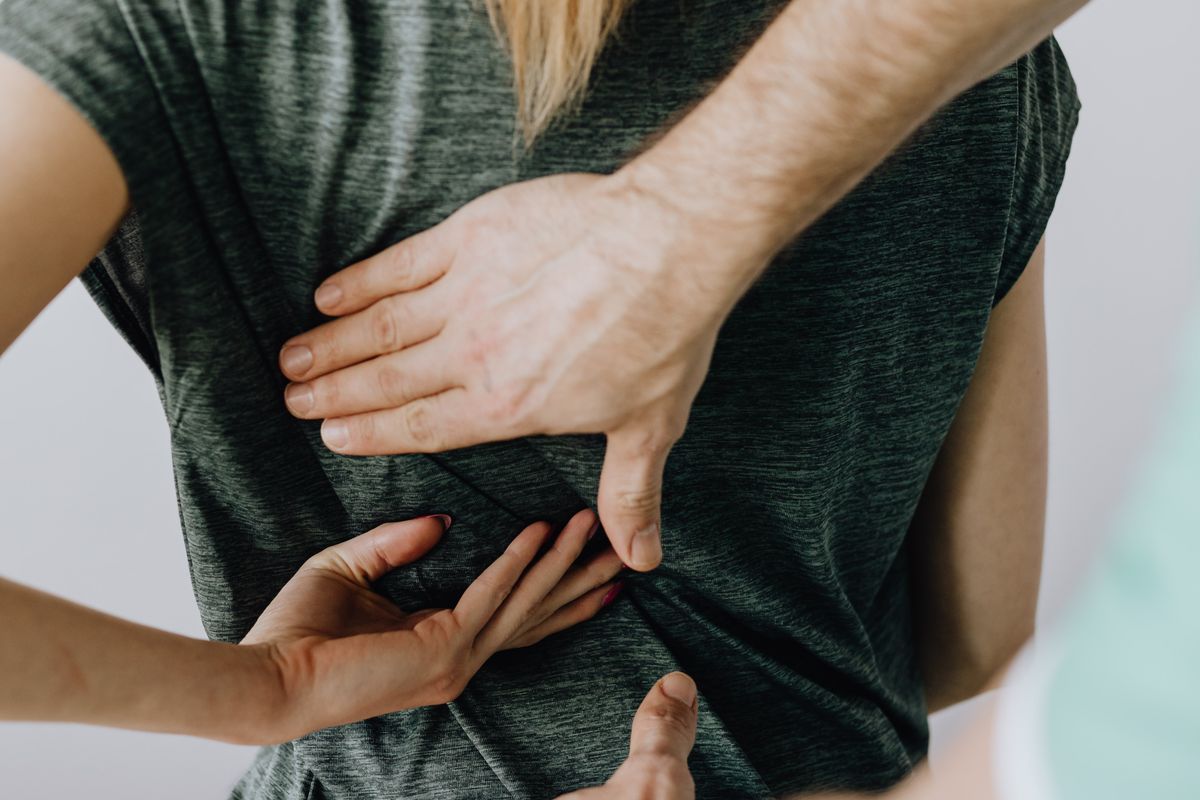
A meaningful share of the "lower back pain" that walks into our Woodlands office isn't coming from the lumbar spine at all. Research estimates that 15 to 25 percent of chronic low back pain originates in the sacroiliac joint — the joint where your spine's base meets your pelvis. It's a distinction that matters, because SI joint pain famously doesn't respond to treatment aimed at the wrong joint.
Meet the joint you didn't know you had
You have two SI joints, one on each side, connecting the sacrum to the iliac bones of the pelvis. They're built for stability, not mobility — they move only a few millimeters, transferring load between your upper body and legs with every step. Strong ligaments hold them together. When one becomes either too stiff or too loose, or when its load-sharing gets asymmetric, the joint and its dense ligamentous web become a persistent pain generator.
The SI joint's signature
Classic SI pain is one-sided, felt below the beltline over the dimple at the back of the pelvis, sometimes referring into the buttock, groin, or back of the thigh (rarely past the knee — unlike true sciatica). It flares with transitions: standing up from a chair, getting out of the car, climbing stairs, rolling over in bed, standing on one leg to dress. Prolonged standing or sitting on the affected side aggravates it. Patients often point at it with one finger — lumbar pain tends to be pointed at with a whole hand.
Why it gets misdiagnosed
SI pain overlaps with disc pain, hip pathology, and piriformis syndrome, and it barely shows on standard imaging — an X-ray or MRI of an aggravated SI joint usually looks normal. Diagnosis is clinical: a cluster of provocation tests that stress the joint in different directions. When several reproduce your exact pain, the SI joint is confidently implicated. This is bread-and-butter chiropractic examination, and it's the step that so often gets skipped when everything below the ribs gets labeled "lumbar strain."
Who gets it
Pregnant and postpartum women (ligament laxity plus load changes), runners and golfers with asymmetric mechanics, people with leg-length differences, anyone after a fall onto the buttock or a car accident, and lifters who twist under load. It's also common after lumbar fusion surgery, when the SI joints inherit motion the fused segments gave up.
How it's treated
The approach depends on whether the joint is stuck or unstable. Restricted SI joints respond well to specific chiropractic adjustments — this is one of the conditions where manipulation has its strongest track record — along with soft-tissue work on the piriformis, glutes, and hip flexors that anchor the region. Unstable or hypermobile SI joints (common postpartum) need the opposite emphasis: stabilization exercise targeting the glutes and deep core, and sometimes a temporary SI belt. Getting stuck-versus-loose right is the whole game, and it's why cookie-cutter treatment fails this joint so often.
If your "back pain" lives below the beltline, favors one side, and hates stairs and car seats, it deserves an exam that actually tests the SI joint. Treat the right joint and this is one of the most solvable pains we see.